

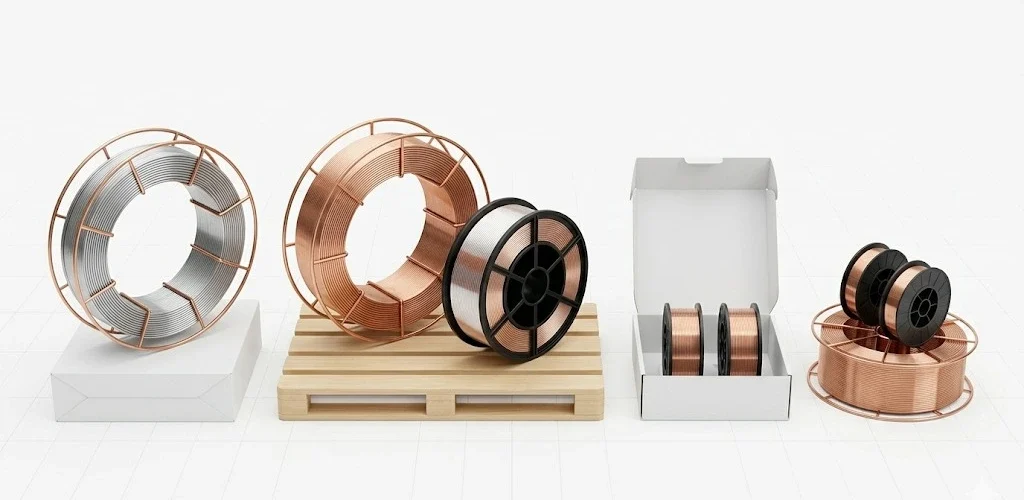
Welding wire – 3 popular solutions for different applications
Welding wire is one of the most important consumables in the welding process. It directly affects arc stability, weld quality, and overall working comfort. Therefore, choosing the right solution plays a key role in achieving reliable results.
In this guide, we compare three popular options. As a result, you can more easily match the right solution to your needs. Moreover, you will understand their key features and typical applications. A well-matched welding wire also helps reduce spatter and improve efficiency in daily work.
Solid MIG/MAG wire for standard applications
First of all, many users choose solid wire for everyday workshop and production tasks. This solution provides stable arc control and ensures a clean weld. In addition, it allows better precision during operation.
Because of its properties, this type works especially well with low-carbon steel. For this reason, workshops and manufacturers often rely on it for repeatable results.
| Parameter | Value |
|---|---|
| Type | Solid wire |
| Welding method | MIG/MAG |
| Material | Low-carbon steel |
| Available diameters | 0.8 mm / 1.0 mm / 1.2 mm |
| Shielding gas | CO₂ or gas mixture |
| Main advantages | Stable arc, clean weld, low spatter |
MIG/MAG wire applications
Solid wire performs well in automotive workshops, metal fabrication, and light steel structures. Furthermore, it is suitable for repair work. Thanks to its versatility, it remains one of the most commonly used solutions.
High-strength filler wire for demanding applications (Welding wire)
Next, users often choose high-strength wire for more advanced projects. This option provides better resistance to stress and vibration. Therefore, it is ideal for structural and industrial applications.
In addition, alloying elements improve mechanical performance. As a result, the weld becomes more durable and reliable over time.
| Parameter | Value |
|---|---|
| Type | Alloy / high-strength wire |
| Welding method | MIG/MAG |
| Composition | Steel with Mn/Si additives |
| Available diameters | 1.0 mm / 1.2 mm |
| Shielding gas | Ar + CO₂ mixture |
| Main advantages | High durability, resistance to stress |
Filler wire applications
This type is commonly used in steel construction, machinery production, and heavy equipment repair. Moreover, it performs well in demanding environments. Because of this, professionals rely on it for critical tasks.
Flux-cored wire for gasless welding
Finally, flux-cored wire offers a different approach. Unlike other options, it does not require shielding gas. As a result, it provides greater mobility and flexibility.
Additionally, it allows quick setup in outdoor conditions. Therefore, it works well for installation and fieldwork.
| Parameter | Value |
|---|---|
| Type | Flux-cored wire |
| Welding method | Gasless welding |
| Shielding | Self-shielded |
| Available diameters | 0.8 / 0.9 / 1.0 mm |
| Main advantages | Mobility, no gas required |
Gasless welding applications
This option is ideal for construction sites, outdoor repairs, and installation work. In addition, it performs well when gas access is limited. Therefore, it is a practical solution for mobile tasks.
How to choose the right welding consumable?
To choose correctly, first consider your working conditions. Then evaluate the material and required strength. As a result, you can avoid mistakes and improve weld quality.
In summary, solid wire fits everyday work. Meanwhile, high-strength solutions suit demanding structures. On the other hand, flux-cored wire works best for mobility.
Which welding solution is the best choice?
Each option offers different advantages and performs best under specific conditions. Therefore, before buying, define your priorities. For example, you may need versatility, durability, or mobility.
A properly selected welding wire improves efficiency, increases weld quality, and reduces potential issues. Ultimately, this comparison helps you choose the right option for workshop, industrial, or field use.