





Description
Innovative corn cob abrasive for industry – eco-friendly abrasive blasting and vibratory finishing with INGRITECH
Modern industry demands solutions that combine maximum surface treatment efficiency with environmental responsibility and operator safety. The corn cob abrasive supplied by INGRITECH (Eu-Grits range) is an innovative, 100% biodegradable and eco-friendly abrasive of plant origin. It is made from the hard, woody part of the corn cob and offers an ideal low-dust alternative to conventional mineral or metallic media. Thanks to its unique structure and optimal physical properties, this abrasive enables highly precise cleaning, drying, polishing and edge rounding processes with no risk of damaging the substrate.
Why choose corn cob abrasive?
Substrate protection
As a soft-grit abrasive, the material removes dirt, coatings and deposits without affecting the base structure, part geometry or fine details of the treated components.
Occupational safety (OHS)
The absence of crystalline silica eliminates the risk of silicosis and cancer. No nanoparticles means full protection of operators’ respiratory systems.
High durability
A Mohs hardness of 4.5 (comparable to iron) and exceptional attrition resistance allow the media to be recycled repeatedly in a closed loop (up to 4–5 times).
Absorbency and cleanliness
The alveolar cellular structure effectively absorbs liquids, water, oils and greases during vibratory finishing, leaving the surface dry and clean.
Material characteristics
Natural corn cob abrasive is distinguished by its specific biological structure and excellent mechanical properties:
- Natural origin: The raw material comes from controlled corn cultivation covering 26,000 hectares in Hungary, ensuring full renewability and a stable supply. Every batch is certified free from genetic modification (GMO-free).
- Biodegradability: The material is 100% organic and fully biodegradable, so it requires neither costly disposal nor laborious collection of spent media from open sites after work is completed.
- Workplace and environmental safety: As an organic substance, it does not conduct electricity and does not spark on impact with the substrate, allowing safe work near live equipment or in sensitive zones. It contains no toxic additives or harmful silica dust.
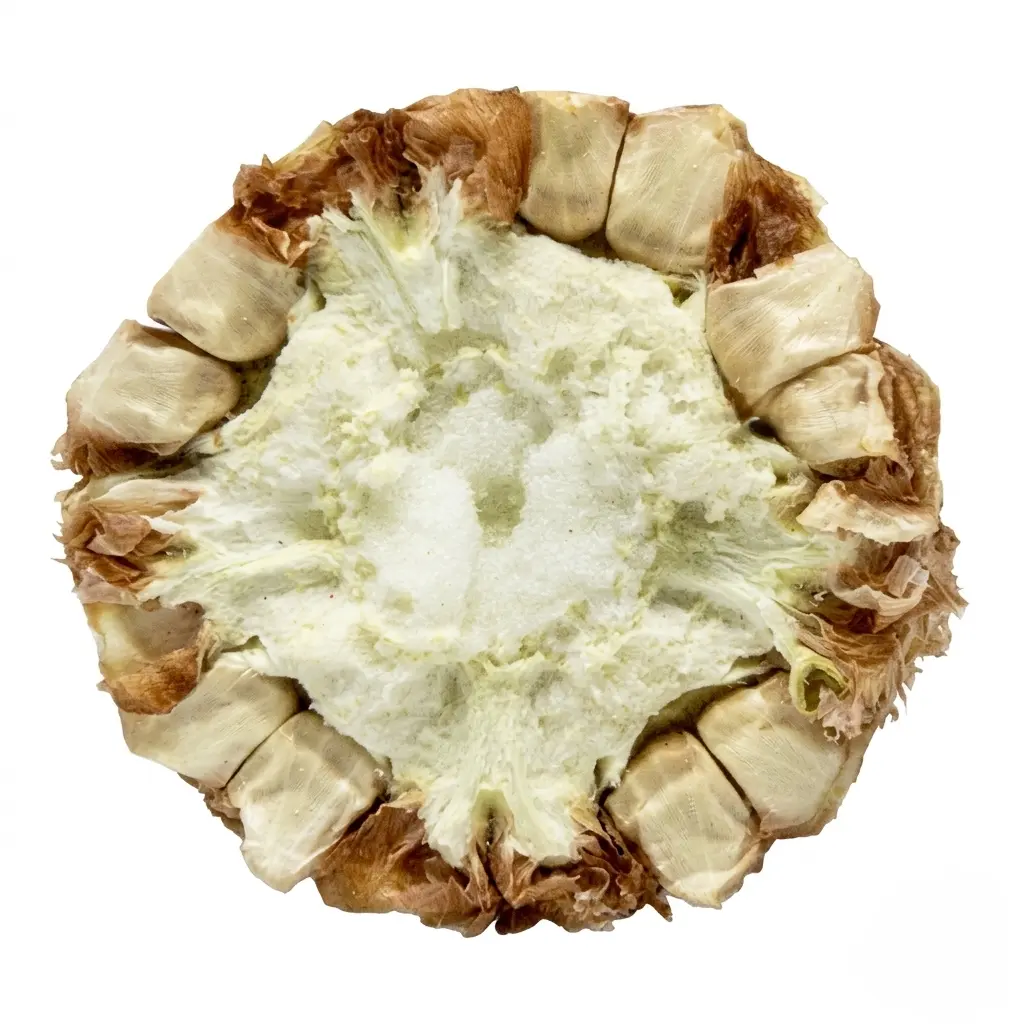
- Grain structure: The Eu-Grits range is produced exclusively from the hard woody ring of the corn cob (the soft pith and chaff are used for the highly absorbent Eu-Feeds range). The woody structure gives the grains a stable alveolar cellular geometry.
- Hardness and resistance: The grains reach a hardness of 4.5 on the Mohs scale, close to that of iron. This enables effective abrading and cleaning while retaining the characteristics of a gentle medium.
- Minimal dust: High mechanical attrition resistance means the grains do not rapidly break down into fine dust on impact, maintaining consistent flow and clear visibility in the blast chamber.
- Absorption capacity: It offers very high absorbency (from 80% up to 300% of its own weight, depending on the grade), which is used for simultaneous drying, degreasing and polishing.
- Service life: It prevents rapid wear of the working media and allows repeated recycling and refilling of blast cabinets and vibratory finishing machines.
Production process
The abrasive is produced through a highly specialised mechanical processing of the plant raw material at a modern processing plant handling approximately 11,000 tonnes of corn cobs per year:
- Raw material selection and harvesting: Corn is harvested whole, cobs included, on contracted farmland under a strictly supervised agricultural scheme without the use of genetically modified seed (GMO-free).
- Drying and shelling: The harvested cobs undergo controlled drying until the moisture content falls below 15%. They are then shelled, precisely separating the corn kernels from the woody cob.
- Crushing and grinding: The woody cobs are delivered to the plant, where they pass through a series of successive physical and mechanical crushing steps and are ground in specialised mills.
- Classification and screening: The crushed material passes through a multi-stage system of screeners and sieves that separates the grades by precise particle size and divides the hard woody ring (Eu-Grits) from the light pith and chaff (Eu-Feeds).
- Quality control and packaging: Before packaging, finished grades are laboratory-tested for particle size distribution, bulk density and final moisture content.
Key properties
Hardness equal to iron
A value of 4.5 on the Mohs scale provides the optimal balance between cutting power and gentleness to the substrate.
Low bulk density
Its low weight (360 to 583 kg/m³) reduces the load on compressors and lowers energy consumption during blasting.
Non-conductive
Its dielectric properties allow use near electrical installations and components.
Quieter operation
Thanks to the low grain weight, the noise generated by the pneumatic system is noticeably lower than with sand.
Wide range of industrial applications
Its versatility makes this material an ideal choice across many industries and trades:
- Cleaning delicate timber structures (softwood and hardwood, conservation of historic wooden buildings).
- Restoration of building facades, monuments and gravestones without damaging the stone or plaster structure.
- Cleaning castings and parts made of aluminium alloys, brass and non-ferrous metals.
- Polishing, degreasing and drying metal and plastic parts after machining.
- Removing rust, mill scale, old paint coatings and sealants from delicate machine components.
- Surface texturing, edge rounding and deburring after stamping and injection moulding.
Abrasive blasting with corn cob grit
Using plant-based grains in abrasive blasting technology delivers excellent results at lower machine operating costs:
Efficiency and ergonomics: Thanks to the light weight of the media, pneumatic hoses are much easier for the operator to handle and the compressor load is significantly reduced. The low specific gravity prevents rapid wear of nozzles and other working parts of blasting equipment.
No need to collect residues: In on-site work (e.g. cleaning building facades, bridges or timber houses), media residues falling to the ground biodegrade naturally, eliminating time-consuming clean-up and waste disposal.
Typical consumption: For softwood surfaces, the reference yield is approximately 1 tonne of media per 300 m² of treated surface.
Vibratory finishing and surface finishing
In vibratory finishing processes and surface finishing in tub vibrators and polishing machines, the Eu-Grits range plays a key role:
Absorption of oils and moisture: The porous, alveolar cellular structure is exceptionally effective at absorbing residual water, coolant and grinding oils, ensuring a perfectly clean, degreased and dry part surface at the end of the cycle.
No dust generation: Exceptional resistance to vibratory attrition protects the grains from breaking down, keeping the working environment clean and the particle size distribution consistent throughout the process.
Economic benefits for businesses
Introducing organic abrasive into in-house production processes delivers measurable financial and operational savings:
- Reusable 4–5 times: Thanks to their high hardness, GM grains can be recycled and reused in blasting equipment without generating unwanted dust.
- Lower disposal costs: Its biodegradable nature eliminates fees for storing and disposing of hazardous process waste.
- Energy and equipment savings: A lower load on the pneumatic system reduces compressor power consumption and extends the service life of hoses and nozzles.
- Stable annual pricing: Annual supply agreements guarantee a fixed price for the entire year.
Technical specifications
Base technical specification for the Eu-Grits product range, based on the manufacturer’s laboratory tests:
| Technical parameter | Value / description |
|---|---|
| Physicochemical properties of the raw material | |
| Mohs hardness | 4.5 (comparable to iron) |
| Plant part of origin | Hard woody ring of the corn cob (corncob woody ring) |
| Final moisture content | Below 15% (< 15%) |
| Biodegradability and eco status | 100% organic, environmentally clean, GMO-free |
| Occupational safety (OHS) and environment | |
| Free silica content | None (0%) – no risk of silicosis or cancer |
| Nanoparticles | Absence of nanoparticles |
| Electrical conductivity and sparking | Non-conductive, non-sparking (safe in sensitive zones) |
| Plant standards and certifications | |
| Plant certifications | ISO 9001, GMP B2 |
| Regulatory compliance | Directive 2002/32/EC (control of undesirable substances) |
Grit sizes and application parameters
Overview of standard Eu-Grits grades, including particle size range, bulk density, water absorption (Westinghouse method) and recommended application:
| Grade | Application | Process type | Notes |
|---|---|---|---|
| GM 6 (2000 µm – 4500 µm) |
Coarse cleaning, removal of thick layers of contamination. | Abrasive blasting / vibratory finishing | Bulk density: 360–460 kg/m³ Absorption: ± 80% |
| GM 8 (1500 µm – 3150 µm) |
Cleaning moderately soiled parts. | Blasting and vibratory finishing | Bulk density: 405–495 kg/m³ Absorption: ± 90% |
| GM 12 (1000 µm – 2000 µm) |
General-purpose cleaning and polishing of metal parts. | Blasting / vibratory finishing | Bulk density: 477–583 kg/m³ Absorption: ± 100% |
| GM 16 (710 µm – 1500 µm) |
Precision surface treatment, degreasing of parts. | Blasting / vibratory finishing | Bulk density: 477–583 kg/m³ Absorption: ± 200% |
| GM 20 (560 µm – 1000 µm) |
Cleaning hardwood (5 bar), facades (5 bar), aluminium surfaces (5–6 bar). | Abrasive blasting (blasting technology) | Bulk density: 477–583 kg/m³ Absorption: ± 250% |
| GM 30 (250 µm – 710 µm) |
Cleaning delicate softwood (2.5–3.5 bar). Precision finishing. | Gentle blasting / vibratory drying | Bulk density: 450–550 kg/m³ Absorption: ± 300% |

Quality control and safety standards
Grain reliability and top quality are ensured by a multi-level quality control system applied at every stage of the production cycle:
- Laboratory testing of every batch: Detailed particle size distribution analysis, final moisture control and bulk density measurement for every shipping batch.
- Compliance with feed directives: Application of Directive 2002/32/EC requirements for the control of undesirable substances in raw materials and finished products.
- GMP B2 and ISO 9001 certification: Full HACCP hazard analysis to prevent physical, microbiological and chemical hazards.
Summary
By choosing organic corn cob abrasive from INGRITECH, you invest in a modern, eco-friendly and highly cost-effective surface treatment solution backed by stable annual pricing. Contact our technical advisors to select the optimal grit size and working pressure for your application.
